

Airplane Banner Towing: How Aerial Advertising Takes Flight
Few advertising formats deliver the recall rates and audience reach of aerial advertising. Airplane banner towing puts brand messages directly in front of crowds at beaches, sporting events, and festivals where traditional media cannot compete.
Van Wagner operates as the largest aerial advertising company in the U.S., with more than 50 years of experience flying campaigns for Fortune 500 brands and regional businesses alike. This article covers how the banner towing process works, the types of banners available, and where aerial campaigns deliver the strongest results.
What Is Airplane Banner Towing?
Airplane banner towing is a method of aerial advertising where single-engine aircraft pull large advertising messages behind them as they fly over targeted locations. These banners function as mobile billboards, traveling directly to where audiences gather rather than waiting for people to pass by a fixed location.
The scale of these banners creates immediate visual impact. Aerial billboards range from 2,400 to 4,000 square feet of advertising space. To put that in perspective, picture a small house laid flat and flying through the sky.
Aircraft fly at low altitudes over coastlines, sporting venues, concert grounds, and high-traffic urban areas. An aircraft launching from a coastal airport can fly over dozens of beach communities in one session, reaching hundreds of thousands of people along the way.
The sound of the approaching aircraft draws attention upward before viewers even spot the banner. Once they look up, the message dominates their field of vision. This combination of audio cue and visual scale creates top-of-mind brand awareness with a single advertising placement.
How Airplane Banner Towing Works

Banner towing requires precise coordination between ground crews and pilots. The process involves specialized equipment and skilled flying techniques developed over decades of aerial advertising operations. Two distinct phases define each flight: the banner pickup and the in-flight operations.
The Banner Pickup Process
Banners are too large and create too much aerodynamic drag to take off attached to the aircraft. Instead, pilots pick up banners mid-flight using a grapple hook system.
Ground crews prepare the banner by laying it flat on the grass alongside the runway. A weighted lead pole stabilizes the front of the banner, and the tow rope extends to its full 300-foot length. At the end of the tow rope, crews position a pickup loop between two upright poles. These poles stand about 5 feet high and sit 6.5 feet apart, with a 3/8-inch rope loop draped between them.
The aircraft carries a grapple hook attached to the rear fuselage via a 21-foot safety link. After a normal takeoff, the pilot deploys the grapple hook and allows it to trail behind the aircraft. The pilot then circles back and lines up for the pickup approach.
Flying at approximately 85 mph, the pilot descends toward the poles in a shallow approach. Precision matters here. The pilot must line up exactly with the poles and maintain consistent altitude and speed throughout the approach. As the aircraft passes through the poles, the grapple hook catches the rope loop.
The moment the hook engages, the pilot applies full power and rotates into a steep climb. This technique peels the banner smoothly off the ground rather than jerking it at an acute angle, which could damage equipment or tangle the banner. Within seconds, the banner lifts into the air and trails 300 feet behind the aircraft.
Missed pickups happen occasionally, even with experienced pilots. When the hook passes too high, too low, or off-center, the pilot circles back for another attempt. Pilots who have flown thousands of banner hours describe successful pickups as an emotional rush after the precision required to execute them.
In-Flight Operations and Banner Release
With the banner in tow, the aircraft cruises at 60 to 70 mph. The banner creates significant aerodynamic drag, so pilots fly much slower than they would without a load. Typical flight altitude sits around 1,000 feet above ground level, low enough for audiences to read the message clearly.
Pilots follow predetermined routes designed to maximize audience exposure. A beach route might cover 50 miles of coastline, passing over resort towns, public beaches, and boardwalks. GPS tracking records the flight path and provides real-time proof-of-performance data for advertisers.
After completing the route, the pilot returns to a designated drop zone. A cockpit-controlled release mechanism disconnects the tow rope from the aircraft. A parachute attached to the lead pole controls the banner’s descent, allowing ground crews to recover it safely. Quality banners can be reused for multiple flights across different locations, extending the value of the initial production investment.
Types of Airplane Banners

Two main banner formats dominate airplane towing operations: letter banners and aerial billboards. Each type offers different advantages depending on campaign goals, message length, and budget.
Letter Banners
Letter banners consist of individual characters connected by joints, allowing crews to assemble any message by linking letters together. Two standard sizes exist: 5-foot letters and 7-foot letters.
The 7-foot letters offer better readability from long distances but create more aerodynamic drag. This limits the total message length to about 25 characters. The 5-foot letters trade some readability for the ability to tow longer messages, up to 35 characters.
Prefabricated letters allow same-day message assembly. Ground crews can swap out letters between flights, making letter banners the most flexible option for campaigns requiring frequent message changes. Common uses include short promotional messages, website URLs, phone numbers, and event announcements. Letter banners are the most cost-effective option for text-based campaigns.
Aerial Billboards
Aerial billboards are large nylon cloth canvases with digitally printed full-color graphics. Typical sizes range from 2,400 to 3,200 square feet for airplane-towed versions. The printing process allows for logos, product images, QR codes, and complete brand visuals in high resolution.
Van Wagner’s proprietary wrinkle-free technology keeps billboard messages clear and readable from the ground. Standard banners can develop folds and creases during flight that obscure portions of the message. The wrinkle-free system maintains a flat, crisp presentation throughout the flight.
Aerial billboards take longer to produce than letter banners and cannot be changed as quickly between flights. The trade-off is visual impact. Billboards deliver the highest brand recognition of all banner types, with full-color imagery that creates immediate audience connection.
Logo boards offer a hybrid option, combining a printed logo panel at the front with interchangeable letters trailing behind. This format balances visual branding with flexible messaging for campaigns that need both elements.
Why Airplane Banner Towing Is Effective
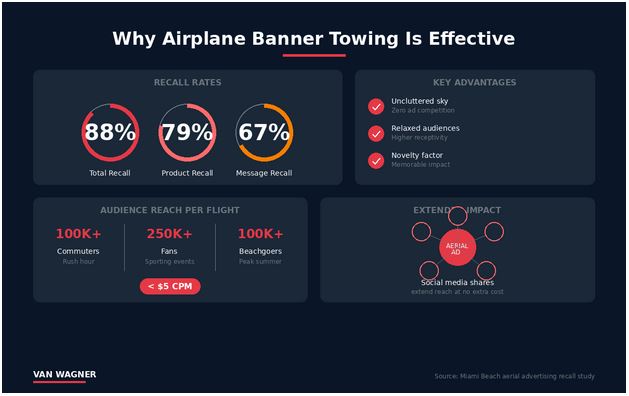
The numbers tell a compelling story about aerial advertising effectiveness.
Surveys show that 88% of people recall seeing an airplane banner within 30 minutes of exposure. Among those viewers, 79% remember the specific product or service advertised, and 67% can recall at least half of the message content. Response rates for aerial campaigns consistently outperform traditional direct mail and digital advertising.
Several factors drive these results. The novelty of aerial advertising contributes to higher retention than traditional formats. People see thousands of digital ads daily, but an airplane banner remains an unusual sight that captures attention. Audiences at beaches, festivals, and tailgates are relaxed and receptive. The uncluttered sky provides zero competition for viewer attention.
The reach numbers are equally strong. A single flight can pass over up to 100,000 commuters during a rush-hour route, 250,000 fans at a major sporting event, or 100,000 beachgoers on a peak summer day. That reach comes at less than $5 per thousand impressions, making aerial advertising one of the most cost-efficient mass-media options available.
Social media extends campaign impact beyond the flight path. Audiences frequently photograph and share banner sightings, generating earned media at no additional cost. Seasonal travel periods like Memorial Day, Fourth of July, and Labor Day weekends offer prime opportunities when beach and highway audiences peak.
Where Airplane Banners Fly
Airplane banners fly over a wide range of venues and events across the country. Primary locations include beaches and coastal areas, NFL and college football stadiums, NASCAR races, music festivals, spring break destinations, state fairs, marathons, and pride celebrations.
Flight restrictions apply to certain events. FAA regulations prohibit aerial advertising flights from one hour before to one hour after major NCAA, MLB, NFL, and NASCAR events. Banners fly during pregame tailgating and post-event departures when crowds gather in surrounding areas. Events like the Super Bowl and NFL Draft draw massive audiences to host cities, creating prime aerial advertising opportunities in the days surrounding the main event.
New York City and Washington D.C. maintain restricted airspace that limits aerial advertising operations. All flights require FAA compliance and proper permits.
Van Wagner operates the only nationwide aerial fleet, with aircraft positioned across all major U.S. markets. This coverage allows for campaigns that run simultaneously in multiple regions or focus on specific local targets.
Frequently Asked Questions
How does a plane pick up a banner?
After takeoff, the pilot circles back and uses a grapple hook to snag a rope loop stretched between two ground poles. Once the hook engages, the pilot climbs steeply to lift the banner into flight position.
How big are airplane banners?
Letter banners display up to 35 characters using individual 5-foot or 7-foot tall letters. Aerial billboards range from 2,400 to 4,000 square feet, roughly the size of a small house.
Can airplane banners fly anywhere?
Banners fly over most outdoor venues and events nationwide. Restricted areas include New York City and Washington D.C. airspace, plus temporary restrictions during major league sporting events.
What is the difference between banner towing and skywriting?
Banner towing displays physical banners behind aircraft. Skywriting uses smoke trails to form letters in the sky. Skytyping uses multiple planes flying in formation to create dot-matrix style messages that are larger and more readable than traditional skywriting.
How do I get started with airplane banner advertising?
Contact Van Wagner for a free campaign assessment. The team will develop a custom strategy based on your target audience, geographic focus, and campaign goals.