

Captive Audience Aerial Advertising: Why Sky-High Messages Command Attention
When a plane flies overhead towing a bold, full-color banner, people stop what they’re doing and look up. That instinctive response is what makes captive audience aerial advertising one of the most effective forms of out-of-home media available today.
Ground-level advertising faces an uphill battle. Billboards blur past drivers at 65 mph. Digital ads get scrolled, skipped, or blocked. Consumers have trained themselves to tune out the constant noise of marketing messages competing for their attention.
The sky offers something different: an ad-free zone where a single message stands alone against an open canvas. No clutter. No competition. No skip button.
This is where the “wow” factor comes into play. Aerial advertising doesn’t just reach audiences; it stops them mid-activity and holds their attention through spectacle and novelty. Van Wagner has delivered this kind of impact for more than 50 years, building the largest aerial advertising operation in the United States. The results speak for themselves: higher recall rates, stronger brand recognition, and audiences who actively engage rather than passively scroll.
How Aerial Advertising Turns Any Crowd Into a Captive Audience

Aerial advertising creates captive audiences through a fundamentally different mechanism than traditional place-based media. Understanding how this works requires examining what “captive” really means, how the “wow” factor triggers attention, and what the recall data reveals about effectiveness.
What Makes an Audience “Captive”
Traditional captive audience environments rely on confinement. Elevator riders, waiting room patients, and transit passengers see ads because they cannot easily leave. These settings work through forced exposure, and the audience remains passive throughout.
Aerial advertising takes a different approach. Instead of trapping viewers, it earns their attention through novelty and spectacle. The mechanism is simple but effective: when people hear an aircraft overhead, they look up. It’s an instinctive response that crosses all demographics and age groups.
Once eyes turn skyward, a bold message against an empty blue canvas commands complete focus. There are no other ads competing for attention. No notifications pinging. No second screen to check. The audience becomes captive not through confinement, but through genuine engagement.
The “Wow” Factor That Commands Attention
The “wow” factor represents that moment of surprise and emotional response that makes a message stick. In advertising, it’s the difference between being seen and being remembered.
Aerial advertising delivers this response consistently. The format itself is unexpected. Most people encounter dozens of digital ads daily, but seeing a message formed in the sky or trailing behind an aircraft breaks the pattern of everyday experience. That novelty triggers stronger memory encoding than repetitive formats ever can.
Consider skytyping, where aerial ads form letter by letter across the sky. Audiences don’t just glance and move on. They watch until the message completes, often for several minutes. Messages can span over half a mile and remain visible for miles in every direction, giving brands extended exposure that ground-level media cannot match.
The spectacle also triggers social sharing. When people witness something unexpected and visually striking, they reach for their phones to capture photos and videos. This organic content extends the campaign’s reach far beyond the flight path, generating impressions that cost nothing extra.
The Recall Rates That Prove It Works
The data behind aerial advertising supports what observers experience in real time. Studies show that 88% of viewers recall seeing an aerial banner within 30 minutes of exposure. That rate significantly outperforms traditional billboard advertising.
The numbers go deeper. Among those who see aerial advertising, 79% recall the specific product or brand being advertised. And 67% can recall at least half of the message content, a retention rate that digital banner ads rarely achieve.
Why does aerial outperform? Novelty creates emotional engagement. Emotional engagement encodes memory. When people feel surprised or delighted by how they receive a message, they remember what that message said.
Where Captive Audiences Gather and the Formats That Reach Them
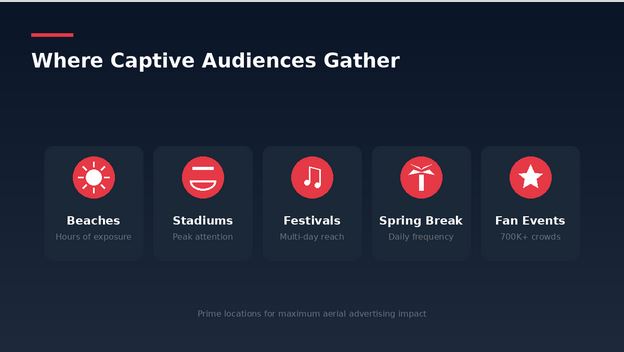
Successful aerial campaigns start with location selection. Certain venues consistently produce captive audience conditions, and understanding what makes these locations effective helps brands plan campaigns that maximize impact.
Prime Locations for Captive Audience Aerial Campaigns
Not all locations offer equal opportunity for aerial advertising. The best results come from places where large crowds gather outdoors with clear sky visibility.
Beaches and vacation destinations rank among the top performers. Sunbathers spend hours facing skyward in a relaxed state of mind. They’re not rushing anywhere, and they’re receptive to messaging that feels like part of the experience rather than an interruption. Aerial billboards with full-color graphics stand out dramatically against blue skies and create memorable brand moments.
Sporting events and stadiums create natural captive audiences. Fans already look up during breaks in the action, making aerial messages nearly impossible to ignore. Major events like the Super Bowl draw millions of eyes skyward, and brands that fly during these moments benefit from the heightened energy and attention of the crowd. Skytyping works particularly well here, with messages unfolding during game pauses.
Music festivals and outdoor concerts offer multi-hour dwell time with unobstructed sky visibility. Helicopter banners provide a hovering presence over specific venues, giving brands sustained exposure throughout performances.
Spring break destinations concentrate target demographics in predictable locations. Daily flights over the same beaches reach the same audiences repeatedly, building frequency and recognition over a week or more.
Major fan gatherings extend beyond single-day events. The NFL Draft attracts over 700,000 attendees across multiple days, creating extended opportunities for aerial exposure. Skywriting delivers guerrilla marketing impact that stands out against urban skylines and generates significant social media conversation.
Why These Locations Deliver Results
Each of these environments shares common characteristics that make aerial advertising effective.
Leisure settings mean audiences are not rushing to their next destination, allowing for longer viewing times.
Extended dwell time means a single flight can generate repeated exposure as the aircraft circles the target area. One campaign reaches the entire crowd multiple times rather than passing by once.
Social atmospheres at games, festivals, and beaches encourage photo-taking and sharing, amplifying campaign reach organically.
Aerial vs. Ground-Level OOH: The Recall Advantage
How does aerial advertising stack up against other out-of-home formats? A direct comparison across key performance factors shows where aerial gains its edge and why those advantages translate to stronger campaign results.
Head-to-Head Comparison
| Factor | Aerial Advertising | Traditional Billboards | Place-Based (Elevators/Transit) |
| Recall Rate | 88% | Lower | Lower |
| Ad Clutter | None | High | Moderate |
| Audience State | Relaxed, engaged | Distracted, driving | Captive but passive |
| Shareability | Very high | Low | Low |
Why Aerial Outperforms
The comparison reveals clear advantages for aerial formats. A single message against an empty sky faces no competition, unlike billboard corridors where multiple signs fight for attention.
Audience state matters as much as visibility. Drivers passing billboards are focused on the road and process ads peripherally at best. Aerial viewers actively choose to look up and watch, creating engagement rather than mere exposure.
From a cost perspective, aerial advertising delivers strong efficiency. CPM runs under $6, making it four times more cost-effective than print advertising. A single flight can reach an entire metro area or event crowd, compared to a billboard that covers one fixed location.
Brands including Coca-Cola, Netflix, DoorDash, and Paramount have seen real campaign results through aerial advertising, building awareness and driving engagement at scale.
Frequently Asked Questions
How long does an aerial advertising message stay visible?
Visibility depends on the format. Aerial billboard flights can last several hours over target areas, circling to maximize exposure. Skytyping and skywriting messages remain visible for 5 to 15 minutes depending on wind and weather conditions.
Can aerial advertising target specific events or demographics?
Yes. Flights are scheduled over specific locations, events, and times based on campaign objectives. Examples include stadium flyovers during games, beach routes during peak afternoon hours, and festival grounds during headline performances. Geographic and timing precision allows demographic targeting without relying on digital tracking or cookies.
What makes aerial advertising more memorable than digital ads?
Physical presence in the real world creates stronger emotional response than screen-based ads. The novelty of sky-based messaging breaks the pattern recognition that causes people to ignore familiar ad formats. The shared public experience of crowds looking up together amplifies social impact and generates word-of-mouth conversation that extends campaign reach.
Ready to put your brand in front of a captive audience? Contact Van Wagner to discuss campaign options for your next product launch, event activation, or brand awareness initiative.